
Kate Warne The First Female Professional Detective in America
In 1856, a young widow walked into Allan Pinkerton’s detective agency in Chicago and asked for a job. Not as a secretary. Not as a clerk. As a detective.
Pinkerton first thought she had misunderstood the work. Private investigation was dangerous, secretive, and almost entirely male. Yet Kate Warne made a practical argument that changed his mind. A woman could enter places men could not. She could gain the trust of wives, sisters, servants, and companions. She could listen without raising alarm.
Pinkerton hired her. With that decision, Kate Warne became the first known woman employed as a professional detective in the United States.
Her career was short, but it changed the shape of American detective work. Warne helped solve cases, gathered intelligence during the tense months before the Civil War, and played a key role in protecting President-elect Abraham Lincoln on his way to Washington, D.C. She also led Pinkerton’s female detective division, training other women for work that much of society believed they could not do.

A mysterious life before the Pinkerton Agency
Much of Kate Warne’s early life remains unclear. That is part of the challenge of telling her story. The lives of women in the 19th century were often poorly documented unless they belonged to wealthy families, famous husbands, or public controversies. Warne’s work also required secrecy, which left even fewer traces behind.
Most accounts place her birth in the 1830s in New York State. By the time she arrived at the Pinkerton National Detective Agency in Chicago, she was a widow. That status mattered. In the social world of the 1850s, a widow could move through certain spaces with more independence than an unmarried woman, but she was still expected to stay within narrow limits.
Warne refused those limits.
Allan Pinkerton later described her as intelligent, calm, and persuasive. She did not rely on force. Her strengths were observation, timing, and the ability to win confidence. Those traits became central to her work.
Private detective work in that period did not look like modern police procedurals. Detectives gathered information through conversation, surveillance, disguise, travel, and patience. For a woman, the role required even more skill. Warne had to work against suspicion from suspects and doubt from colleagues. She had to be convincing in every room she entered.
She was not simply breaking a barrier. She was proving that the barrier had been built on bad assumptions.
Why Allan Pinkerton hired her
Pinkerton’s agency had built its reputation on private investigations, railroad security, and undercover work. The agency’s motto, “We Never Sleep,” later became famous, along with its open-eye symbol. In the 1850s, the business was still developing its methods and public identity.
When Warne asked to become a detective, Pinkerton hesitated. He had not advertised for a woman investigator. He had not planned to hire one. Yet Warne made a case he could not ignore.
Men could question men in taverns, depots, banks, and business offices. But many cases involved domestic circles, social visits, boardinghouses, and private conversations. A male detective might draw attention in those settings. A woman could appear harmless, even invisible. Warne understood that invisibility could become power.
This was not a sentimental argument. It was a tactical one.
A woman detective could:
Speak with women who might avoid male investigators
Enter households without creating immediate suspicion
Pose as a friend, traveler, nurse, seamstress, or companion
Notice social details men often dismissed
Gather information in spaces where men had limited access
Pinkerton recognized the value. In 1856, he brought Warne into the agency.
Warne’s hiring was not a symbolic gesture. Pinkerton used her because she could do work his male detectives could not do as well.
That decision made American investigative history.

Kate Warne’s methods were quiet and effective
Warne did not become known for shootouts or public arrests. Her work centered on undercover intelligence, a skill that rewards restraint. She could adopt a role, build trust, and let people reveal themselves.
One commonly cited case involved an investigation tied to embezzlement from the Adams Express Company. In accounts of the case, Warne gained the confidence of a suspect’s wife and helped uncover information that led to the recovery of stolen money. Details vary across retellings, which is common with early detective history, but the pattern fits what made Warne valuable: she could reach sources who were closed off to male investigators.
Her work also depended on reading behavior. A nudge in conversation. A nervous pause. A detail in a house that did not match a person’s story. Good detectives did not only chase clues. They listened for what people tried to hide.
Warne’s success pushed Pinkerton to rethink who could serve as an investigator. By 1860, he had created a Female Detective Bureau within the agency, and Warne became its superintendent. That meant she did more than take assignments. She helped recruit, guide, and train other women in the field.
That leadership role deserves attention. Becoming the first was rare enough. Building a path for others made her influence larger than her own case files.
The Baltimore Plot made her part of presidential history
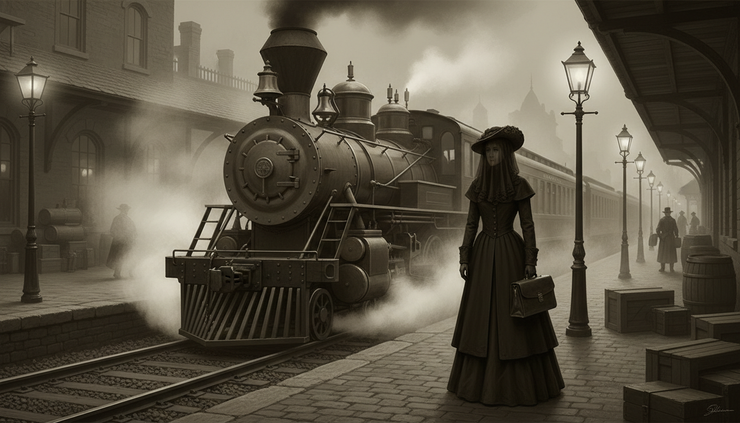
Kate Warne’s most famous assignment came in 1861, just before Abraham Lincoln took office.
The country was on the edge of civil war. Several Southern states had already seceded after Lincoln’s election. Threats against him were taken seriously, especially during his journey by rail from Springfield, Illinois, to Washington, D.C., for the inauguration.
Allan Pinkerton was hired to investigate possible danger along the route. His team focused on Baltimore, a city with strong secessionist sentiment and a rail transfer that created a security risk. Passengers had to move between stations, making Lincoln vulnerable in public.
Warne entered the investigation undercover. She posed as a Southern sympathizer and gathered information in social circles where male detectives would have stood out. Her work helped support Pinkerton’s belief that there was a real plot to attack Lincoln as he passed through Baltimore.
The plan to protect Lincoln required secrecy and speed. Lincoln changed his travel schedule, passed through Baltimore at night, and reached Washington safely before his public arrival was expected.
The episode became controversial. Some critics mocked Lincoln for slipping into the capital quietly. Yet the choice looks different when viewed through the danger of the moment. The nation was breaking apart. The president-elect’s safety was not a matter of pride. It was a matter of continuity.
Warne’s part in the operation showed how important undercover work could be. She did not command troops or give speeches. She collected information and helped make a safe route possible.
She led women in detective work before women had basic rights
Warne’s career stands out even more when placed against the legal and social realities of her time.
Women in the United States could not vote in national elections. Many professions were closed to them. Married women in many states still faced limits on property, wages, and legal independence. Public life was built around the assumption that men acted and women stayed private.
Detective work broke those rules.
It required travel, risk, deception, judgment, and independence. It required a woman to enter public spaces and manage dangerous situations without calling attention to herself. Warne did all of that before the Civil War, before national suffrage, and before modern police systems took shape.
Her work also complicates a simple view of women’s history. Warne did not gain influence by making speeches from a stage. She operated in secrecy. Her public reputation remained thin because her success depended on not being known.
That creates a strange legacy. The better she did her job, the less visible she became.
What made Warne different from fictional detectives
It is tempting to turn Kate Warne into a character from a mystery novel. Her life has all the right ingredients: disguise, secret messages, train stations, spies, and a threatened president. But treating her only as a dramatic figure can flatten what made her important.
She was not a mythic lone genius solving crimes through flashes of brilliance. She was a working investigator in a growing agency. Her tools were discipline, preparation, and emotional intelligence.
Warne’s real strengths were practical:
Skill | Why it mattered |
Observation | She noticed details in behavior, clothing, rooms, and conversation. |
Social fluency | She understood how to move through different social settings without drawing suspicion. |
Patience | Undercover work often required waiting for trust to form. |
Adaptability | She could take on roles that fit the case and the people around her. |
Leadership | She helped establish a place for other women inside the Pinkerton agency. |
Fictional detectives often announce their brilliance. Warne survived by hiding hers.
Her partnership with Allan Pinkerton shaped her legacy
Allan Pinkerton played a major role in preserving Warne’s memory. His writings and agency history helped keep her name from disappearing completely. At the same time, that creates a problem for later readers. Much of what is known about Warne comes through Pinkerton’s perspective, and Pinkerton had reason to promote the agency’s successes.
That does not erase Warne’s achievements. It does mean her story should be read with care.
The broad facts remain powerful. Pinkerton hired her in 1856. She worked as a detective. She became a leader in his female detective division. She helped investigate threats to Lincoln before the inauguration. She died young, in 1868, after barely more than a decade in the profession.
She was buried in Chicago’s Graceland Cemetery, in a plot associated with the Pinkerton family. That final detail says something about the bond between Warne and the agency. She was not treated as a passing novelty. She had become part of the institution.
Why Kate Warne still matters
Kate Warne matters because she changed what detective work could look like.
Her story challenges the idea that early law enforcement and private investigation belonged only to men. It also shows that progress often begins with a practical need. Pinkerton did not hire Warne to make a public statement about equality. He hired her because she could do the job. Once she proved that, the old rule became harder to defend.
That pattern appears often in history. A person enters a field because the work needs their skill, then their presence exposes the weakness of the system that kept them out.
Warne’s example also broadens the meaning of courage. Courage is not always loud. It can look like walking into a room where no one expects you, asking for work no one planned to give you, and then doing it so well that the profession changes.

A short timeline of Kate Warne’s life and career
The records are not complete, but the main arc of Warne’s career is clear.
Year | Event |
1830s | Kate Warne is believed to have been born in New York State. |
1856 | She joins the Pinkerton National Detective Agency in Chicago. |
Late 1850s | She works undercover on criminal investigations, including cases involving theft and fraud. |
1860 | Pinkerton forms a female detective division, with Warne in a leadership role. |
1861 | She helps investigate threats connected to Lincoln’s journey to Washington, D.C. |
1860s | She continues working for Pinkerton during the Civil War era. |
1868 | Warne dies in Chicago while still relatively young. |
The timeline is brief because her life was brief. Yet the influence of that life reaches far beyond the dates.
The first female professional detective in America left a quiet trail
Kate Warne did not leave behind a large archive of personal writings. She did not live long enough to become an elder statesperson of the profession she helped open. She spent much of her career hiding her identity rather than building a public one.
Still, her place in history is secure.
She proved that investigation was not defined by gender. She showed that listening could be as powerful as force, and that access could matter as much as authority. She turned the assumptions of her time into professional advantages.
The title Kate Warne The First Female Professional Detective in America points to a first, but her legacy is larger than being first. She helped create a model for women in investigative work, one built on skill, trust, nerve, and intelligence.
Her story starts with a woman asking for a job no one expected her to hold. It ends with a reminder that history often changes because someone walks through the wrong door and belongs there anyway.



Comments