
Halloween and All Souls’ Day Origins Traditions and Cultural Meaning
Every year, the last night of October opens a door between play and remembrance. Porches glow with jack-o’-lanterns, children become ghosts and superheroes, and candy bowls empty by the hour. Two days later, in churches and cemeteries around the world, candles flicker beside graves as families speak the names of the dead.
Halloween and All Souls’ Day sit close together on the calendar, but they are not the same celebration. One is known for costumes, fright, and festive mischief. The other centers on prayer, memory, and love that continues after death. Still, both grew from a deep human need: to face mortality, honor ancestors, and gather as a community when the year turns dark.
Understanding their origins reveals why these days still matter. They remind people that fear can be transformed into ritual, grief can become connection, and the past is never as far away as it seems.

Halloween began where harvest, spirits, and winter met
Halloween is celebrated on October 31, the evening before All Saints’ Day on November 1. Its name comes from “All Hallows’ Eve,” meaning the eve of All Hallows, or all saints. The holiday as we know it blends Christian observances, older seasonal customs, folklore, and modern community traditions.
One of the most commonly cited influences is Samhain, an ancient Celtic festival marking the end of the harvest season and the beginning of winter. In parts of Ireland, Scotland, and other Celtic regions, this was a threshold time. The warm, productive months were ending. Livestock were brought in. Food stores were prepared. Long nights were coming.
Samhain was also associated with the belief that the boundary between the living and the dead grew thin. Spirits, fairies, and wandering souls might pass near human homes. People lit bonfires, shared food, and took part in protective customs. Some wore disguises, possibly to confuse spirits or avoid being recognized by them.
Over time, Christian observances reshaped the season. All Saints’ Day honored saints and martyrs, while All Souls’ Day focused on all the faithful departed. The evening before All Saints’ Day became All Hallows’ Eve, later shortened to Halloween.
Halloween did not become a major public holiday in the United States all at once. Irish and Scottish immigrants in the 1800s brought customs such as guising, fortune games, and carving lanterns from turnips or other root vegetables. In North America, pumpkins were larger and easier to carve, which helped create the jack-o’-lantern tradition now tied to Halloween.
By the 20th century, Halloween had become more child-centered. Neighborhood trick-or-treating grew in popularity, and the holiday became a night for costumes, candy, parties, haunted houses, and playful fear.
Halloween traditions turn fear into fun
Halloween has always worked with scary symbols, but its staying power comes from the way it makes fear communal and creative. It gives people permission to laugh at what usually unsettles them.
Common Halloween traditions include:
Costumes and masks Dressing up connects to older customs of disguise, but today it also allows imagination to take over. People become monsters, movie characters, animals, historical figures, or clever visual jokes.
Trick-or-treating Children go door to door asking for candy, often with the phrase “trick or treat.” The custom has roots in older practices of visiting homes for food, prayers, or small performances.
Jack-o’-lanterns Carved pumpkins with glowing faces are one of Halloween’s most recognizable symbols. Their roots connect to Irish folklore about wandering spirits and lanterns used to ward off danger.
Haunted attractions and ghost stories Halloween invites people to enter controlled spaces of fear. A haunted house, scary movie, or ghost story becomes thrilling because the danger is imagined.
Divination games Older Halloween customs included games meant to predict future romance or fortune. Bobbing for apples and mirror rituals carried hints of this older magical mood.
In the United States, Halloween has also become a neighborhood holiday. It depends on participation. One house decorates. Another gives candy. Children walk in groups. Parents linger at the sidewalk. Even the spookiest decorations create a kind of welcome.
That mix of darkness and generosity explains much of Halloween’s appeal. It lets people play with death, monsters, and mystery without being consumed by them.

All Souls’ Day remembers the dead with love and prayer
All Souls’ Day falls on November 2 in the Roman Catholic calendar. It is a day to remember and pray for all the faithful departed, especially those who have died but are believed to be in need of purification before entering heaven.
The observance became more formal in medieval Christianity. A commonly cited milestone is the work of Odilo, abbot of Cluny, who promoted a day of prayer for the dead in the late 10th and early 11th centuries. Over time, the practice spread widely through Western Christianity.
All Souls’ Day belongs to a three-day sequence sometimes called Allhallowtide:
Date | Observance | Main focus |
October 31 | Halloween or All Hallows’ Eve | The eve before the feast of all saints |
November 1 | All Saints’ Day | Honoring saints and holy people |
November 2 | All Souls’ Day | Remembering and praying for the dead |
The mood of All Souls’ Day is quieter than Halloween. It is not built around fright or masquerade. It centers on remembrance, mercy, and the belief that the bonds between the living and the dead remain meaningful.
In many Catholic communities, families attend Mass, light candles, visit cemeteries, clean graves, and bring flowers. Names of the dead may be read aloud in church. Some families keep photographs of loved ones at home or prepare special foods connected to memory.
A candle on a grave can carry many meanings. It may symbolize prayer, hope, the soul’s journey, or the simple human desire to say, “You are not forgotten.”
Around the world, remembrance takes many forms
Halloween and All Souls’ Day origins traditions and cultural meaning vary greatly from place to place. Some cultures emphasize playful spirits. Others focus on solemn prayer. Many blend both.
Mexico honors the dead with color and welcome
Mexico’s Día de los Muertos, or Day of the Dead, is one of the best-known examples of cultural remembrance around this time of year. It is often connected with November 1 and 2, overlapping with All Saints’ and All Souls’ observances, while also drawing from Indigenous traditions and Catholic influence.
Families build ofrendas, or home altars, to welcome the souls of loved ones. These may include photographs, candles, marigolds, favorite foods, sugar skulls, water, incense, and papel picado. Graves are cleaned and decorated. Families may spend time in cemeteries, sharing music, food, and stories.
The day is not treated as a denial of grief. It is a way of meeting grief with beauty. The dead are invited back through scent, memory, taste, and song.
The Philippines gathers families for Undas
In the Philippines, the season around All Saints’ Day and All Souls’ Day is known as Undas. Families often travel long distances to visit cemeteries. Graves are cleaned and painted. Candles are lit. Flowers are placed. Families may spend hours together at burial sites, praying, eating, talking, and remembering.
Undas shows how remembrance can also strengthen family ties. A cemetery becomes a meeting place for generations, including those no longer living.
Poland lights cemeteries with thousands of candles
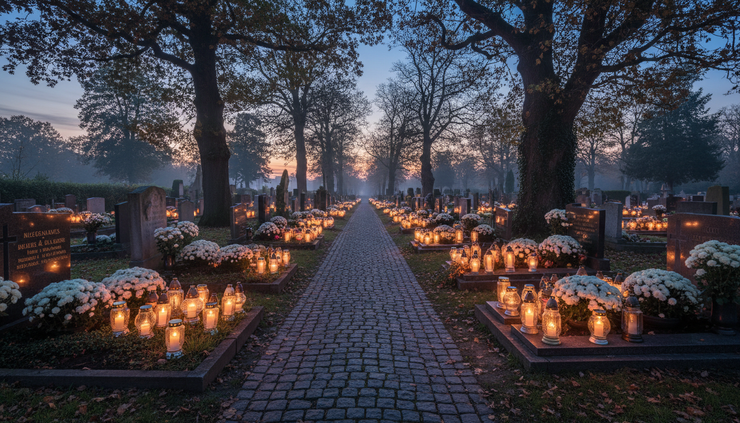
In Poland, November 1 and 2 bring large cemetery visits. Families place candles and flowers, especially chrysanthemums, on graves. At night, cemeteries glow with rows of lights.
The effect is quiet and powerful. Each flame marks a life, a family, and a memory. The ritual makes private grief visible in public space.
Guatemala raises giant kites for the ancestors
In some Guatemalan communities, especially in places known for the tradition, giant colorful kites are flown around the Day of the Dead season. The kites are often understood as a way to communicate with ancestors or guide spirits.
The craft itself matters. Families and communities work together to create huge designs from paper and bamboo. Memory becomes public art.
Haiti marks a different but related season of the dead
In Haiti, Fèt Gede honors spirits of the dead within Vodou tradition, usually in early November. It includes ritual, music, offerings, and visits to cemeteries. While distinct from Catholic All Souls’ Day, it shares the seasonal focus on ancestors and the world of the dead.
This shows how early November became, in many places, a time when spiritual attention turns toward those who came before.
Why these days still matter
At first glance, Halloween and All Souls’ Day may seem like opposites. Halloween is loud, funny, and theatrical. All Souls’ Day is reflective and devotional. One fills sidewalks with costumes. The other fills cemeteries with candles.
Yet both answer similar questions.
What do people do with fear?
How do families carry memory?
How can a community make space for death without losing joy?
Halloween gives fear a costume. It turns the unknown into a game. For children, it can be an early lesson in bravery. A skeleton on the lawn may look frightening, but it also becomes funny. A dark street feels safer when neighbors open their doors.
All Souls’ Day gives grief a ritual. It offers a set time to return, remember, pray, clean, decorate, and speak names. For many families, that structure matters. Grief can feel shapeless, but a candle, a flower, a song, or a visit gives it form.
These celebrations also preserve cultural identity. Immigrant families keep recipes, prayers, songs, and cemetery customs alive across generations. Communities pass down stories through annual repetition. A child may not know every detail of family history, but they remember the smell of marigolds, the cold night air at the cemetery, or the way a grandparent said a name.
Interesting facts that reveal deeper meaning
A few details show how layered these observances are:
Pumpkins became the classic Halloween lantern in North America because they were easier to carve than turnips and widely available in fall.
The colors orange and black fit the season naturally. Orange suggests harvest, leaves, pumpkins, and fire. Black suggests night, mystery, and death.
Soul cakes were once part of customs in parts of Europe. People, often children or the poor, received small cakes in exchange for prayers for the dead.
Marigolds used in Day of the Dead traditions are sometimes called flowers of the dead. Their bright color and strong scent help guide the mood of welcome.
Cemetery visits on All Souls’ Day are not only acts of mourning. They can also be acts of maintenance, respect, and family storytelling.
Across cultures, food plays a central role. People bake, share, offer, or eat dishes tied to memory. Food makes remembrance physical. It says that the dead are still part of the household story.
How people honor loved ones today
Modern remembrance does not always look religious, but it often keeps the same emotional shape. People still seek ways to connect with those they have lost.
Some light a candle at home. Some visit a grave. Some cook a parent’s favorite meal. Some create a small table with photographs and flowers. Others tell family stories, play a song, donate in someone’s memory, or gather with relatives for a quiet meal.
A simple remembrance ritual might include:
Choose a photo or object connected to the person.
Light a candle or place flowers nearby.
Say their name aloud.
Share one true story about them.
End with gratitude, prayer, silence, or music.
The form can be simple. The point is attention. Ritual slows people down long enough to remember with care.

The shared message of Halloween and All Souls’ Day
Halloween and All Souls’ Day endure because they speak to something older than any single custom. They help people cross the uneasy bridge between life and death.
Halloween says that darkness can be met with imagination, laughter, and community. All Souls’ Day says that the dead deserve memory, prayer, and tenderness. Together, they turn late fall into a season of courage and connection.
Whether through a carved pumpkin, a candlelit grave, an altar of marigolds, or a story told at the kitchen table, these days invite the living to remember. The most lasting tradition is not the costume or the candy. It is the act of keeping love visible, even after loss.


Comments